.png)
How Family and Friends Can Help a Toddler Feel Safe (and Be Themselves) During Chinese New Year
- Shirlyn

- Feb 13
- 4 min read
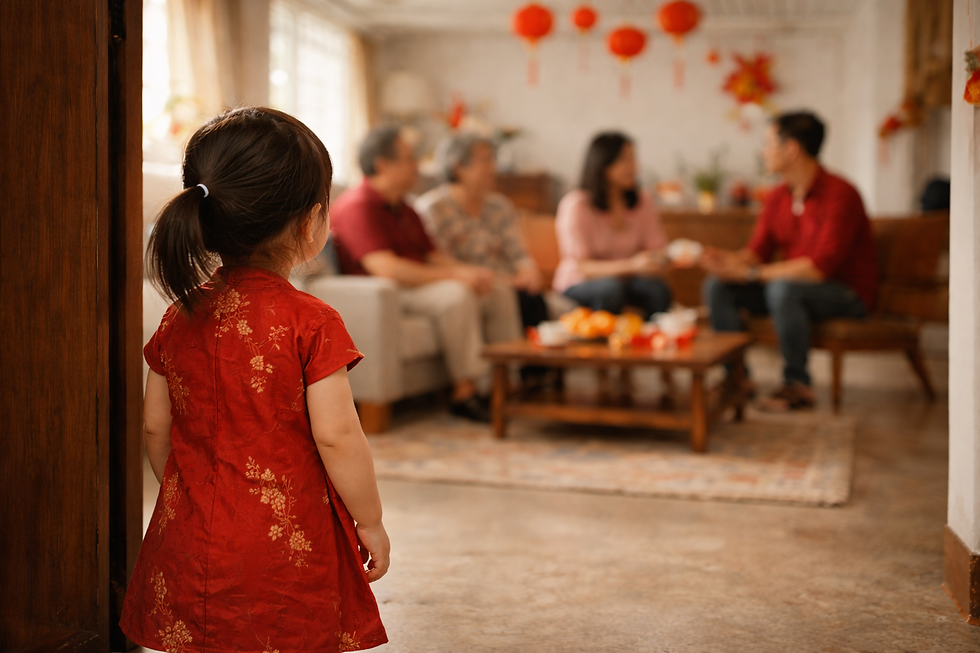
Chinese New Year is often described as joyful, meaningful, and full of togetherness.
For adults, it usually is.
For toddlers, however, it can be loud, unfamiliar, and emotionally demanding — all at once.
New homes. New faces. Big emotions from adults. Subtle expectations they don’t yet understand.
When toddlers “act differently” during festive gatherings — clinging, hiding, refusing greetings, melting down, or withdrawing — it’s easy to assume they’re being shy, difficult, or poorly behaved.
More often, they’re doing something developmentally appropriate:
They’re checking whether they feel safe enough to be themselves.
This builds on what I shared earlier about respectful parenting during Chinese New Year - where I explored how expectations, routines, and adult responses shape a child's sense of safety in festive settings. View post here.
Chinese New Year with Toddlers: Why Feeling Safe Comes Before Social Behaviour
Toddlers don’t enter new environments thinking, How should I behave?
They enter thinking, What’s happening here, and am I okay?
At this age, behaviour is closely tied to nervous system regulation.
When a child feels emotionally safe, their capacity for interaction expands.
When they don’t, their system prioritises protection.
This is why toddlers may appear confident in familiar settings but withdrawn in others — not because they are inconsistent, but because safety is contextual.
Why Festive Expectations Can Overwhelm Toddlers
Family gatherings are full of good intentions.
Adults want greetings, smiles, hugs, photos, and proof of connection.But for toddlers, being asked to perform social behaviours before they feel ready can be overwhelming.
What adults experience as politeness or festive spirit, toddlers experience as pressure.
Resistance isn’t rejection.It’s regulation.
How Family and Friends Can Support Toddler Safety
You don’t need specialised knowledge to support toddlers during Chinese New Year.Small, respectful choices matter.
Let Toddlers Arrive in Their Own Time
Some toddlers walk straight in.
Some need ten minutes.
Some need much longer.
There is no correct timeline.
Waiting without commentary — no coaxing, teasing, or labelling — communicates safety more clearly than reassurance ever could.
Observe Before You Engage
Before asking a toddler to greet, respond, or interact:
Sit nearby
Watch what they’re drawn to
Comment gently on what you see
Connection begins when toddlers feel seen, not summoned.
Respect Boundaries, Even Brief Ones
No hugs.
No greetings.
No photos — for now.
Respecting a toddler’s “no” doesn’t spoil them.
It teaches them that their body and voice are respected.
Children whose boundaries are honoured often initiate connection later, on their own terms.
Choose Language That Creates Safety
Language can either calm or escalate.
Avoid:
“Don’t be rude”
“Say properly”
“Why are you so scared?”
Try:
“You can wave if you want”
“You can stay close”
“Take your time — I’m here”
These phrases don’t remove expectations; they soften them enough for toddlers to meet them when ready.
Be the Calm Anchor
Toddlers borrow emotional regulation from the adults around them.
A calm tone, slower movements, and relaxed expectations help a toddler’s nervous system settle far more effectively than instructions or encouragement.
Festive joy is contagious — but so is tension.
A Quick Shareable Guide for the Village
If you'd like something simple to share in family chats or pass along before visiting, I've created a one-page printable:
Chinese New Year with Toddlers: How the Village Can Help
It's short, respectful, and designed to be easily shared with grandparents, relatives, and friends.
Let Toddlers Be Who They Are
Some toddlers observe.
Some move constantly.
Some talk endlessly.
Some say very little.
None of these are problems to correct.
Chinese New Year doesn’t require toddlers to be louder, braver, or more outgoing than they are.
It simply asks adults to make room.
What Toddlers Will Actually Remember
Toddlers won’t remember:
how much angbao they received
who they greeted
how well they “performed”
They will remember how they felt in their bodies:
safe or rushed
respected or overridden
accepted or corrected
Those feelings shape how they approach family gatherings long after the decorations come down.
A Note for Grandparents & Relatives
It’s often a sign they’re still settling.
Your patience, calm presence, and willingness to wait are powerful ways of building trust — and trust is what allows connection to grow naturally.
If you're navigating Chinese New Year with young children, you may also find this guide helpful: Chinese New Year Visiting With Young Children - A Calm, Respectful Approach.
The Gift That Lasts
This Chinese New Year, the most generous thing we can offer toddlers isn’t compliance or performance.
It’s belonging — without conditions.
That is what makes celebrations feel safe enough to be joyful.
References & Further Reading
Cassidy, J., & Shaver, P. R. (Eds.). (2016). Handbook of attachment: Theory, research, and clinical applications (3rd ed.). Guilford Press.
Coan, J. A., & Maresh, E. L. (2014). Social baseline theory and the social regulation of emotion. Current Opinion in Psychology, 1, 87–91. https://doi.org/10.1016/j.copsyc.2014.08.021
Gunnar, M. R., & Hostinar, C. E. (2015). The social buffering of the hypothalamic–pituitary–adrenocortical axis in humans: Developmental and experiential determinants. Developmental Psychobiology, 57(4), 416–429. https://doi.org/10.1002/dev.21313
Siegel, D. J., & Bryson, T. P. (2012). The whole-brain child: 12 revolutionary strategies to nurture your child’s developing mind. Delacorte Press.
Perry, B. D., & Winfrey, O. (2021). What happened to you? Conversations on trauma, resilience, and healing. Flatiron Books.


Comments